
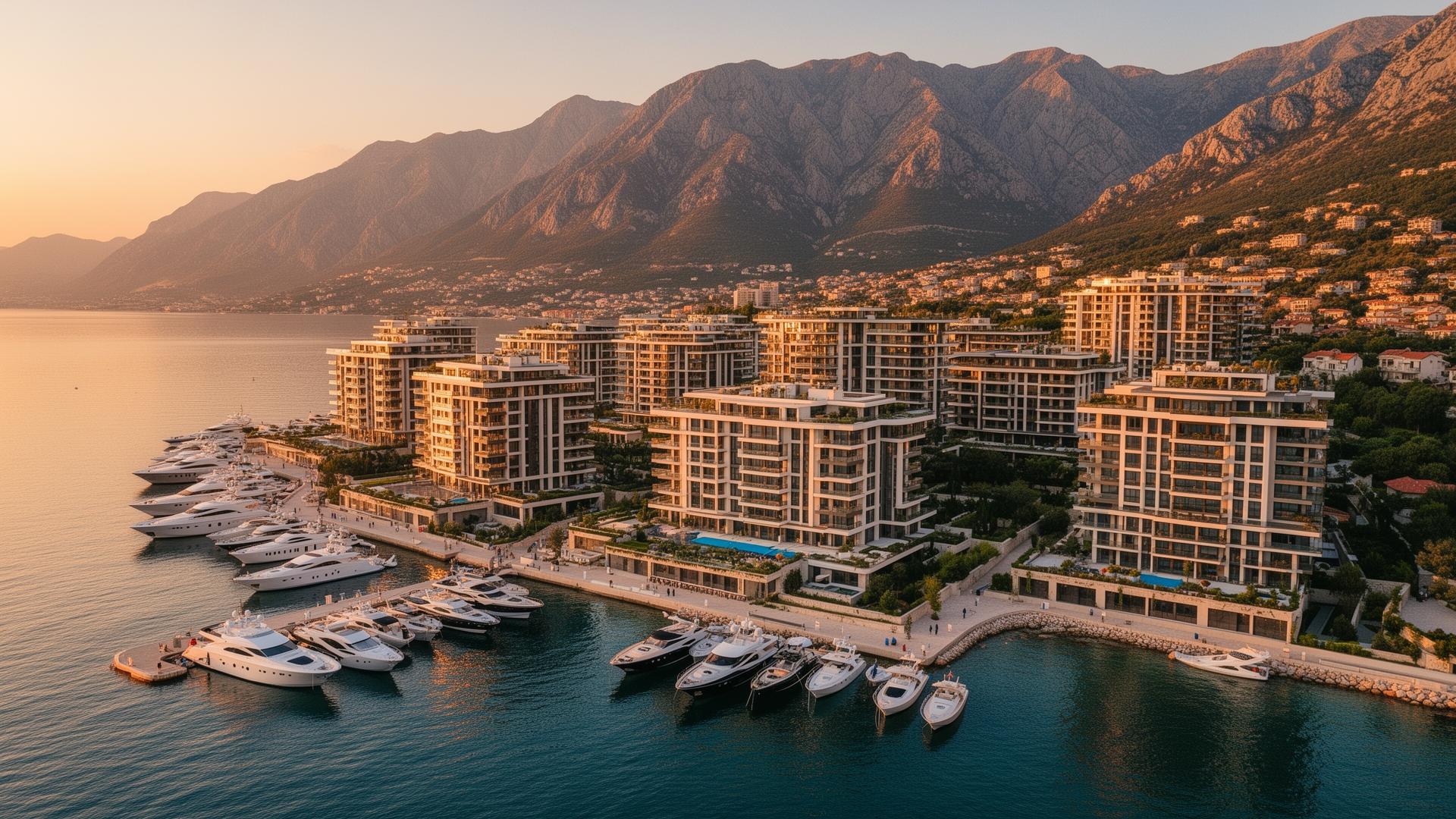
Montenegro has delivered 19 consecutive quarters of year-on-year residential price growth as of Q3 2025. It uses the euro, has no foreign ownership restrictions on residential property, a 15% flat income tax rate, and a credible EU accession timeline targeting 2028. This article breaks down whether the investment case holds up - and where the risks actually sit.
The market in numbers: 2025–2026
Sources: MONSTAT, Global Property Guide, Investropa, Chestertons. The headline figures explain why international capital has been quietly rotating into the Montenegrin coast over the past three years.
- Budva waterfront: €2,800–€3,200/sqm. Luxury: €4,000+/sqm.
- Kotor Old Town area: €2,600–€2,900/sqm.
- Porto Montenegro (Tivat): €6,000–€12,000/sqm for prime marina units.
- Podgorica: €2,153/sqm average in Q3 2025, up 18% YoY.
- FDI in real estate: €284.92M in the first 8 months of 2024.
Rental yield profile by location
Montenegro's rental market splits between short-term tourism-driven coastal properties and long-term residential demand in Podgorica. Yield profiles differ significantly by market type.
| Location | Gross yield | Net yield (est.) | Demand driver |
|---|---|---|---|
| Budva coastal | 5.40–6.75% | 3.5–5.0% | STR tourism (seasonal) |
| Kotor Bay | 4.44–4.81% | 3.6–4.8% | STR tourism + expats |
| Tivat / Porto Mne. | 4.44–4.81% | 3.0–4.0% | Luxury STR, yachting |
| Podgorica | 6.06–6.90% | 4.5–5.5% | Long-term residential |
| Kolašin (ski) | 6–8% (est.) | 5–6% (est.) | Dual-season ski/nature |
Net yields for fully managed STR coastal properties are significantly compressed by management fees (20–30%), cleaning, platform fees, and income tax. Realistic owner payout: 45–60% of gross revenue. Podgorica long-term yields are more stable and operationally simpler, but lack the appreciation narrative.
The EU accession angle
Montenegro has been an official EU candidate since 2010 - the longest-standing active candidate. As of early 2026, 13 of 35 negotiation chapters have been provisionally closed, and European Commission officials project accession negotiations could conclude by end-2026, with membership by 2028–2029. In November 2025, Montenegro joined SEPA - enabling same-day, low-cost transfers with EU countries.
The 5-year price forecast from multiple analyst sources projects cumulative appreciation of 25–40% in the base case, equating to roughly 4.5–7% annual growth. Property prices outside the coastal strip have not yet priced in full accession - that gap represents the upside thesis.
Three investment tiers
Montenegro's property market divides into three distinct investment profiles with different risk/return dynamics.
Luxury Coastal
- ·Porto Montenegro, Luštica Bay, Sveti Stefan zone
- ·€6,000–€15,000/sqm at premium marina units
- ·Institutional-quality branded residences, managed hotel pools
- ·Strong capital appreciation story; yield compressed by price
- ·Target: UHNWI buyers, lifestyle + appreciation motive
Prime Coastal
- ·Budva, Kotor Bay, Tivat hinterland, Herceg Novi
- ·€2,000–€4,500/sqm depending on location and sea view
- ·Best yield-to-appreciation balance on the coast
- ·STR demand strong June–September; winter strategy required
- ·Target: income-seeking investors with 5+ year horizon
Value Plays
- ·Podgorica, Kolašin (ski), northern coastal towns
- ·National average €2,228/sqm; inland significantly lower
- ·Podgorica: stable long-term yield (6–7%), lower seasonal risk
- ·Kolašin ski zone: dual-season demand, 6–8% gross yield (estimate)
- ·Target: yield-first investors, lower capital entry requirement
Tax environment and transaction costs
| Item | Rate / Amount | Notes |
|---|---|---|
| Property transfer tax | 3% of market value | Resale properties. New builds: VAT included |
| Rental income tax | 15% flat rate | After deductions. Registered STR: 50–70% deduction |
| Capital gains tax | 15% on net gain | Deductions for acquisition cost, improvements, fees |
| Annual property tax | 0.25–1% of cadastral value | Municipality-dependent. Cadastral < market |
| Legal fees | 0.5–1% of purchase price | Highly recommended for foreign buyers |
| Notary fees | ~€300–600 | Mandatory for all property sales |
| Total transaction costs | 4–8% of purchase price | Resale; 2.5–5% new build (VAT included) |
The risks: what to price in
EU accession delay
The accession timeline has slipped repeatedly - agents predicted 2022, 2023, 2025. The 2028 projection is more credible than prior ones, but delay is the base-case risk for the appreciation thesis. Prices have already moved in anticipation; if accession stalls, momentum slows.
Seasonal concentration
Coastal STR income is concentrated in 90–120 days. Off-season income depends on active winter management. A property sitting idle October–April generates no cash but accumulates costs.
Supply growth in coastal tier
Significant new-build pipeline in Budva and Tivat zones. New supply competing with existing stock could compress occupancy and yields, particularly in the mid-market segment.
Price level after 20%+ growth
Prices rose 20%+ in 2024 and again in 2025. Entry prices are no longer cheap by regional standards for coastal prime. The remaining upside is accession premium, not cheap valuations.
Governance and legal risk
Montenegro's land registry and planning permit systems have historically been inconsistent. Thorough due diligence through a local lawyer is non-negotiable. Unpermitted construction and disputed ownership still occur.
Currency (indirect)
Montenegro uses the euro but is not in the EU or Eurozone officially. Euro use is unilateral - there is theoretical currency risk if Montenegro were ever to abandon it, though this scenario has very low probability.
Frequently asked questions
Evaluating a buy-to-let acquisition?
Mighty Montenegro manages short-term rental properties along the Montenegrin coast. We can assess a property's rental potential, realistic annual income, and operational requirements before you commit.
Talk to us →